


A customizable ecommerce platform matters because it helps online sellers make better decisions about their operating workflow. The strongest approach evaluates the topic against audience needs, credible evidence, and the practical implementation steps required to improve growth. This commercial guide turns the idea of a “customizable” stack into a concrete selection and implementation plan you can execute with confidence.
What customizable ecommerce platform means for online sellers

Make the opening concept easier to understand by showing the operational decision context facing ecommerce teams.
In practical terms, a customizable ecommerce platform is software that lets you shape the shopping experience and back-office workflow to your business model, without fighting the system. Customization spans three layers:
Experience layer: Themes, components, content, and checkout flows that you can adapt to brand, catalog, localization, and accessibility needs.
Operations layer: Order routing, inventory rules, pricing logic, subscriptions, returns, tax/shipping settings, and approvals that reflect how your team actually works.
Integration and data layer: APIs, webhooks, data models, and event streams that connect your store to ERP, WMS, CRM, marketing automation, marketplaces, and analytics.
For a new seller, “customizable” should first mean safe speed: fast to launch, opinionated defaults, and changes you can make in the admin without writing code. For a growing brand, it should mean scalable control: programmatic customization, modular services, and the ability to evolve catalog, checkout, and operations without full rewrites.
Because “customizable” is often used loosely, set an explicit evidence standard when comparing options. Reserve comparative or superlative claims (for example, “best,” “fastest,” “most flexible”) for cases where you have verifiable proofs such as hands-on demos, working prototypes, or implementation references that match your use case. Everything else should be framed as capabilities to be confirmed.
Core customizable ecommerce platform considerations
Before shortlisting, align on shared terminology and decision criteria. This creates a fair comparison across vendors and keeps conversations focused on your outcomes, not feature tours.
Business model fit
B2C, B2B, or hybrid? Do you need account-based pricing, quotes, purchase orders, or complex tax rules? Can the platform handle bundles, kits, configurable products, and large catalogs with custom attributes?
Customization modes
Configuration (no-code admin settings), extensions/apps (pluggable modules), APIs (headless or composable builds), and code-level (SDKs, functions, or serverless workers). Decide where your team wants control and where you want guardrails.
Architecture stance
Monolithic SaaS, open-source, PaaS, headless, or fully composable. Your choice affects speed to value, change costs, vendor lock-in, and the team skills required to maintain the stack.
Operational depth
Order management, fulfillment routing, inventory reservations, returns/exchanges, and subscription lifecycle management. Confirm native support versus partner apps or custom builds.
Data model and extensibility
Custom entities and attributes, flexible pricing models, webhooks for events, and the ability to export/import data reliably. Check rate limits and versioning policies.
Governance and security
Roles/permissions, audit logs, SSO, and environment isolation (dev/stage/prod). Ensure that access control is granular enough for merchandising, operations, finance, and development teams.
Evidence threshold
For claims that impact cost or risk, ask for working demos on your sample data, a proof-of-concept environment, and documentation that covers limits, rollout steps, and maintenance responsibilities.
How to evaluate customizable ecommerce platform
Support the central comparison framework with a clear visual representation of the criteria and trade-offs discussed in the article.
Use Platform Selection as a structured process instead of a feature scavenger hunt. Anchor your comparison to the research basis you capture in your DigiShop proposal: audience needs, operating workflows, constraints, capability map, proof plan, and rollout steps. Treat every vendor claim as a hypothesis until it is proven against your specific workflows.
This customizable ecommerce platform guide recommends building evaluation criteria around confirmed capabilities. Avoid declaring any option “best” until you see it perform your high-risk workflows under realistic load and data conditions.
Evaluation framework
Break the assessment into concrete criteria, trade-offs, and proof points. The list below is intentionally practical; adapt it to your workflows and stage.
Business and catalog model
Criteria: Product types, variants, bundles, configurable attributes, content relationships, and large-catalog navigation.
Trade-offs: Simpler product models ship faster but may limit merchandising creativity. Deeply flexible models enable sophisticated bundles and personalization at the cost of higher governance needs.
Proof points: Model three representative SKUs (simple, configurable, bundle) and verify import/export, search facets, and merchandising rules in a sandbox.
Pricing, promotions, and tax
Criteria: Tiered pricing, B2B contracts, quotes, coupons, automatic discounts, and tax/shipping engines.
Trade-offs: Native promotion engines reduce app sprawl; external engines offer precision but add latency and vendor overhead.
Proof points: Build a promotion matrix that combines product, segment, and order thresholds, then execute test orders across regions.
Experience and content
Criteria: Theming, design systems, content modeling, multilingual, multi-currency, and accessibility.
Trade-offs: Headless/composable gives maximal front-end freedom; integrated storefronts accelerate time to first value with guardrails.
Proof points: Recreate your PDP and checkout with your design tokens. Validate page templates, translations, and personalization rules.
Checkout, payments, and risk
Criteria: One-page checkout, wallets, subscriptions, multi-address shipping, saved payment methods, and fraud/risk tooling.
Trade-offs: Built-in gateways simplify settlement; multi-gateway strategies diversify risk and improve acceptance but add complexity.
Proof points: Run a test plan across major payment methods, high/low ticket sizes, and edge cases like partial captures and split shipments.
Operations and fulfillment
Criteria: OMS features (splits, backorders, reservations), returns/exchanges, store pickup, and carrier integrations.
Trade-offs: Native OMS streamlines operations; specialized OMS may be necessary for complex multi-node routing or SLAs.
Proof points: Simulate a high-volume sale with inventory thresholds. Verify pick/pack flows, return authorizations, and notifications.
Integration ecosystem
Criteria: ERP, WMS, PIM, CDP/CRM, marketing, marketplaces, and support for custom connectors.
Trade-offs: App ecosystems speed integration but can fragment data ownership. Direct API builds give control but require sustained engineering.
Proof points: Map your current tools, then validate two-way sync on a critical integration (for example, ERP inventory and order status).
Data, analytics, and extensibility
Criteria: Event streams, data exports, custom entities, reporting, and warehouse connectors.
Trade-offs: Scheduled exports are simpler but lag; real-time streams improve decisions but require observability and governance.
Proof points: Emit checkout and order events to your analytics destination; confirm schema stability and replay options.
Performance, reliability, and environments
Criteria: Caching/CDN strategy, image optimization, concurrency handling, release pipelines, and environment isolation.
Trade-offs: Fully managed hosting reduces ops toil; DIY infrastructure enables fine-tuning but shifts reliability risk to your team.
Proof points: Load-test your PDP and checkout in a non-production environment with realistic traffic and data.
Governance, security, and compliance
Criteria: Role-based access, audit logs, SSO/SAML, secrets management, and change control.
Trade-offs: Granular permissions improve control but require process maturity; broad roles are simpler but increase risk.
Proof points: Set up roles for merchandising, operations, finance, and developers; review logs after your PoC to verify traceability.
Total cost of ownership (TCO) and vendor viability
Criteria: Licensing, usage-based fees, app spend, implementation costs, and internal staffing needs.
Trade-offs: Lower up-front licensing can mask higher ongoing maintenance. Higher subscription tiers can reduce app sprawl and custom code.
Proof points: Build a 24–36 month TCO model that includes expected order volume, traffic, catalog size, and team time. Align contract terms to your growth plan.
Evidence and implementation checks, questions to ask vendors
Which parts are configurable versus extensible via apps, APIs, or code? Provide examples using our sample catalog and checkout rules.
What are the hard limits (rate limits, variant counts, function execution time, payload sizes), and how are limits increased as we scale?
How do you isolate environments for development, testing, and production? What does a safe rollout look like?
What happens during peak events? Share playbooks for caching, queueing, and incident response.
Which capabilities are first-party versus partner-provided? Who supports what in production?
Evidence and implementation checks, proofs to collect
Hands-on sandbox with your products, promotions, and content models.
Prototype checkout covering your top three payment methods and one edge case (split shipment or partial capture).
Integration spike to your most critical system (often ERP or WMS) with two-way sync.
Performance test results on PDP and checkout with your media assets and data sizes.
Governance validation: roles, approval flows, and audit logs exercised by your team.
Commerce, reconnected
Bring your storefront closer to launch.
DigiShop unifies your storefront, checkout, analytics, and growth operations so your next commerce experience can move from idea to live faster.
Request early accessImplementation guidance and next steps

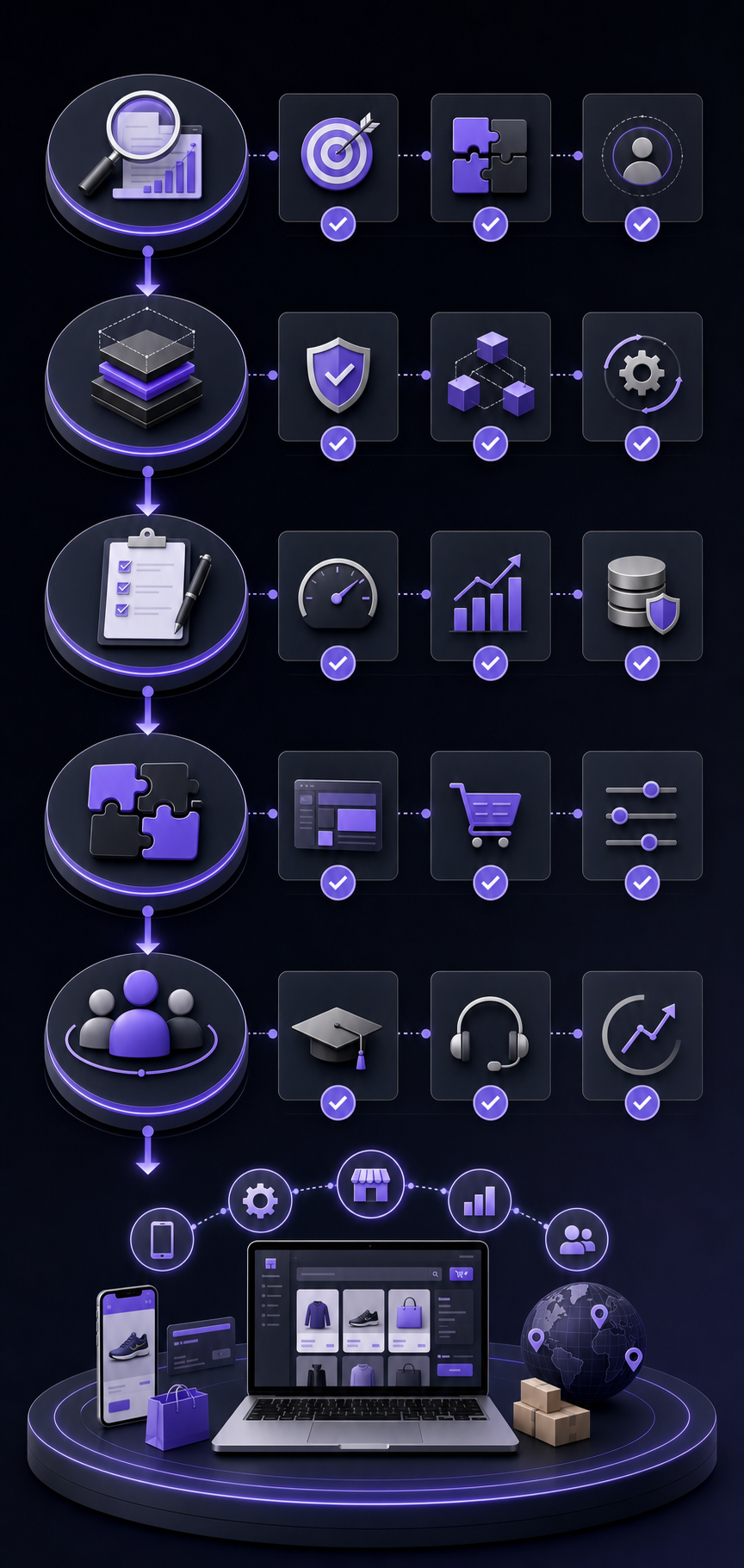
Reinforce the final action plan with a visual sequence that helps readers understand how implementation moves from decision to execution.
Translate evaluation into an ordered plan that addresses risk first, then value acceleration. Keep your documentation tight: decisions, assumptions, proofs gathered, and open risks. This creates continuity from Platform Selection through build, launch, and growth.
Match your approach to your stage:
New seller: Favor opinionated defaults and an all-in-one commerce platform to minimize handoffs. Customize via configuration and vetted extensions; defer headless until you feel friction you cannot resolve with settings or apps.
Growing brand: Keep the core stable, then unbundle hotspots. Move the front end, pricing logic, or OMS to specialized services if those areas block growth, while maintaining clear SLAs and observability across services.
Document proof and source requirements as you go. Each capability you plan to depend on should have a corresponding artifact: demo recording, PoC repo or configuration export, step-by-step runbook, limits documented, and owner assigned.
Prioritized implementation plan
Charter and outcomes
Owner: Commerce lead
Action: Define revenue, margin, and operational targets tied to specific workflows (for example, PDP to checkout conversion, pick/pack time, returns processing).
Validation: Agree on KPIs and acceptance criteria for each capability you will test and implement.
Discovery and capability mapping
Owner: Product manager
Action: Interview merchandising, operations, customer support, and finance. Convert findings into a capability map categorized by risk and impact.
Validation: Stakeholder sign-off on the map; use it as the single source of truth.
Shortlist and plan the proofs
Owner: Engineering lead
Action: Select 2–3 platforms that meet baseline requirements. Define PoC scenarios for catalog, checkout, and one operational flow.
Validation: Written test plans with pass/fail criteria and data sets.
Proof-of-concept sprints
Owner: Cross-functional squad
Action: Execute 1–2 week sprints per platform. Build a thin vertical slice from PDP to settlement and a key back-office flow.
Validation: Demos on your data; logs and screenshots archived; blockers and workarounds documented.
TCO and risk model
Owner: Finance partner
Action: Estimate 24–36 month costs (licenses, apps, build/run, headcount) and risk buffers (peak events, replatform triggers).
Validation: Present trade-offs with scenarios (baseline, growth, stress) and decision thresholds.
Reference and roadmap checks
Owner: Commerce lead
Action: Speak with reference customers that match your model. Review public product roadmaps and change policies.
Validation: Documented notes mapped to your capability risks; confirm support boundaries.
Contract and SOW alignment
Owner: Legal and procurement
Action: Align terms with your growth plan: usage bands, environments, support SLAs, and exit/migration rights.
Validation: Schedules and exhibits reflect the proofs you ran and the environments you need.
Pilot build and limited launch
Owner: Delivery manager
Action: Implement the vertical slice that delivered the most value in PoC. Limit audience (for example, one region or channel) to lower risk.
Validation: Uptime and conversion meet acceptance criteria; rollback plan rehearsed.
Full migration and enablement
Owner: Operations lead
Action: Complete data migrations, finalize roles/permissions, and train teams with task-centered runbooks.
Validation: Cutover checklist signed by each function; post-launch hypercare staffed and scheduled.
Stabilize and iterate for growth
Owner: Product manager
Action: Establish a quarterly roadmap of improvements: performance budgets, content ops, new channels, and A/B testing.
Validation: KPI reviews and incident retros feed the next quarter’s backlog.
If you need a single-vendor path, connect relevant needs to an all-in-one commerce platform and lean on configuration and vetted extensions. If you need deeper differentiation, select a customizable ecommerce platform for ecommerce as the foundation and compose specialized services where they unlock measurable growth.
Platform choices also need a safe publication process. An supplement compliance workflow shows how to review claims before they reach customers.
Frequently Asked Questions
What should sellers evaluate when considering customizable ecommerce platform?
Start with business model fit, then test catalog flexibility, checkout extensibility, and operational depth. Confirm integration pathways to your ERP/WMS/CRM, review governance and security controls, and model the 24–36 month total cost of ownership. Insist on proofs that use your products, promotions, and workflows, not generic demos.
How does customizable ecommerce platform affect ecommerce growth?
It changes the slope of your growth curve by reducing friction in key workflows, merchandising, checkout, and fulfillment, while preserving control where differentiation matters. The right choice lets you ship improvements quickly, measure outcomes, and unbundle hotspots when needed without destabilizing the rest of the stack.
What evidence should support a customizable ecommerce platform decision?
Collect hands-on proofs: a sandbox with your data, a working checkout prototype, an integration spike to a critical system, performance test results, and governance validation. Pair those artifacts with a written rollout plan and cost model so decision-makers can weigh impact, risk, and ongoing effort.