


Summary Overview
Activating affiliates on day one does not mean waiting for partners to discover a listing and hoping they promote it. It means giving qualified affiliates an offer worth evaluating, clear economics, reliable tracking, compliant assets, a fast approval path, and a partner experience that helps them decide what to promote next. A marketplace can create discovery, but vendor execution determines whether the first click becomes sustained distribution.
Treat marketplace visibility as the start of recruitment, not the entire affiliate strategy.
Give affiliates product economics, conversion context, approved claims, and ready-to-use assets before outreach begins.
Use tracking links and campaign keys to learn which partner and promotion model creates qualified revenue.
Build a launch rhythm around approval speed, partner feedback, asset updates, and measured optimization.
To activate affiliates on day one, sellers need more than a marketplace listing. They need a partner-ready offer, clear approval rules, compliant promotional assets, accurate tracking, and a simple process for helping affiliates understand what converts and how they will be supported. This guide shows you a practical launch operating system that separates discovery, recruitment, approval, enablement, attribution, optimization, and relationship management, so your first day is more than a spike of curiosity. It becomes the foundation for repeatable distribution.
What day-one affiliate activation really requires
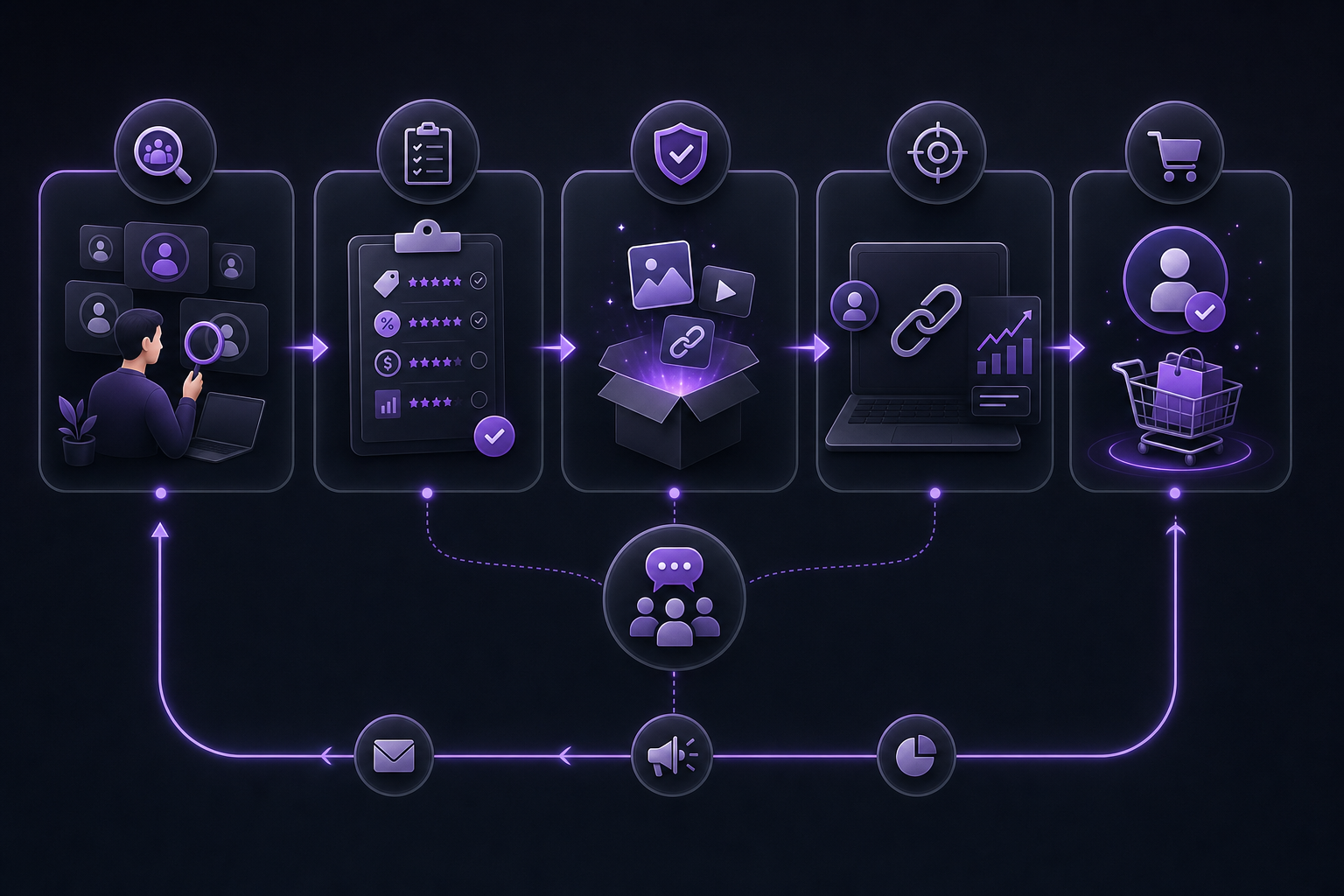
Show that activation combines discovery, offer readiness, enablement, attribution, and relationship management.
Most vendors equate listing a product in an affiliate marketplace with activation. That mistake leads to slow starts, mismatched partners, and orphaned links. Day-one activation means you do four things at once: make your offer easy to evaluate, remove friction from partner onboarding, provide credible and compliant assets, and instrument links so you can learn what works. The marketplace creates discovery. Your system creates performance.
Marketplace access creates discovery, not automatic promotion
Marketplaces give affiliates a catalog to search, filter, and compare. In Digistore24, affiliates can scan each listing’s headline, product image, sales page link, affiliate support page link, and key figures such as earnings per sale, cart conversion, and cancellation rate, then click Promote now to request partnership or copy a promolink after approval. That makes discovery efficient, but it does not guarantee anyone will promote you. An affiliate still judges product market fit, economics, proof, and operational ease before committing space in their calendar. (Digistore24 affiliate getting started guide)
Even when a vendor sets an attractive commission, seasoned affiliates still ask if the product is ready for their audience, if the funnel is trustworthy, and if working with the vendor will be simple. They want the right economics, the right story, and a smooth path from click to conversion.
The affiliate decision framework
Affiliates who can move volume think like portfolio managers. Before they send a single click, they evaluate seven areas:
Audience fit: who exactly buys, and will this vendor’s positioning resonate with that audience’s current demand and objections.
Offer quality: product readiness, customer support setup, fulfillment or onboarding reliability, and refund realities.
Economics: commission structure and earnings per sale relative to typical traffic costs and the affiliate’s opportunity cost.
Conversion context: sales page strength, checkout clarity, and any conversion boosters such as bonuses or deadlines.
Compliance and trust: approved claims, required disclosures, and boundaries on copy and creative.
Operational ease: fast approval, a single contact for questions, and access to assets built for speed.
Attribution confidence: link types, cookie window, campaign keys, and reporting hygiene that make results visible. (Digistore24 affiliate getting started guide)
Your job is to pre-answer these questions in your listing, your affiliate support page, and your outreach. That is what turns passive visibility into day-one activation.
Build an offer affiliates can evaluate quickly

Give a visual representation of the information affiliates evaluate before deciding to promote an offer.
Affiliates do not promote potential. They promote clear offers that are easy to understand and easy to sell. Prepare a partner-facing brief that shows audience fit, positioning, proof, and transparent terms at a glance. Do not rely on vague hype or inflated claims. You need clarity, not theatrics.
Clarify the buyer and the transformation
Affiliates look for a believable transformation that matches their audience. Describe the buyer precisely: who they are, what they have tried, what holds them back, and what changes after purchase. Avoid generic superlatives. Use concrete language that sets scope and expectation. If you sell a course, define the learner’s starting point, the exact skills they gain, and the time investment. If you sell a supplement, define the use case, the necessary context or lifestyle factors, and limits on what can be claimed. Your copy should help an affiliate picture where to insert your offer inside their own content without rewriting their editorial calendar.
Make your promise specific, qualified, and evidenced. Replace “best in class” with “built for [use case], proven to [practical outcome] when [conditions].” If you cannot say it credibly, do not say it. Affiliates protect their own trust first.
Make commercial terms easy to understand
Spell out commission model, payout expectations, and rules the same way you would draft a clean statement of work. Use simple bullets on your affiliate support page:
Commission structure: percentage or flat amount, what qualifies as a sale, and whether upsells, order bumps, or subscriptions are included.
Refund context: typical cancellation windows and how commission reversals are handled, expressed in plain language.
Approvals: what qualifies an affiliate for auto approval versus manual review, plus what information to include in an application so review is fast. In Digistore24, a vendor may require manual approval before the affiliate can copy a promolink, so state your criteria up front. (Digistore24 affiliate getting started guide)
Operational contacts: a dedicated email and expected response times for asset requests, custom tracking, or clarifications.
Affiliates will respect conservative language if it removes surprises. They leave when math is fuzzy or terms feel one sided.
Prepare the proof partners need
Proof persuades. Provide a clean sales page, a concise demo or walkthrough, and a short set of approved talking points. Organize social proof into what it proves: clarity of use, quality of support, verified outcomes, or satisfaction. Set evidence boundaries. Tell partners what not to claim and what compliance language to include with every promotion. If a testimonial references a result, ensure it is contextualized and representative, not an outlier. Offer a media kit with product images, logos, and usage rules. The goal is to save your partners from guesswork, not to turn them into your copywriters.
Create an affiliate enablement kit before launch

Make the asset system and tracking requirements easier to understand.
Enablement reduces activation friction. Build your kit before the listing goes live. That way the moment an affiliate clicks Promote now, they can start without waiting for you to produce assets or answer basic questions.
The minimum viable affiliate kit
Give new partners a short, organized package that answers how to present the offer, where to send traffic, and what to say safely. Your minimum viable kit should include:
Marketplace listing that matches your sales page and includes essential metrics and links to the sales page and affiliate support page. (Digistore24 affiliate getting started guide)
Affiliate support page with: audience definition, core benefits, approved claims and disclosures, terms, contact channel, and a version number so partners know they are current.
Promolinks and content links: make both easy to find. The promolink leads to the sales page. A content link lets an affiliate cook a visit on an upstream asset such as a webinar or article before the buyer reaches your sales page. Provide examples for each. (Digistore24 affiliate getting started guide)
Campaign keys guidance: show how to append CAMPAIGNKEY to links so partners can separate email, social, and ad traffic in reports. (Digistore24 affiliate getting started guide)
Creative: 3 to 5 email starters, short and long blurbs, a few headlines and social captions, and at least two static images sized for common placements. Keep copy within your compliance rules.
FAQ: short answers about audience fit, common objections, refunds, and how to request custom creatives or bonus pages.
Approval experience: an application template, what you review, and how quickly you respond. In Digistore24, affiliates may see their promolink immediately or after manual approval, so set that expectation clearly. (Digistore24 affiliate getting started guide)
Build a changelog. When you retire an outdated claim or asset, note the date and why. Affiliates need to know when to swap creative. A kit that changes with no notice breaks promotions and erodes trust.
Promolinks, content links, and attribution discipline
Use the right link for the job, then keep link hygiene strict:
Promolink: the default link to your sales page. When a buyer clicks a promolink, an HTTP cookie is stored that enables attribution for up to 180 days, subject to the buyer’s browser behavior. This is generous, but only if you keep links intact. (Digistore24 affiliate getting started guide)
Content link: a link an affiliate compiles to set the cookie earlier in the journey, such as on a webinar page, then later send the buyer to your sales page. This is ideal for content driven funnels where the sales page is not the first touch. (Digistore24 affiliate getting started guide)
Campaign key: an optional parameter, CAMPAIGNKEY, that separates one promotion from another in reporting. Teach partners to assign a unique key per channel or creative concept, then read outcomes by key inside Reports. (Digistore24 affiliate getting started guide)
Respect the mechanics. Do not shorten or alter tracking links in ways your platform warns against. If your affiliates want branded links for aesthetics, provide acceptable methods that preserve parameters. When you add new creative, ship ready-to-paste links with recommended campaign keys so partners do not have to build them by hand. In Digistore24, creating or viewing links happens in the affiliate view under Sales and partners or Account areas, and content links may require a short approval window on weekdays. Communicate that timeline during launch. (Digistore24 affiliate getting started guide)
Approved claims and compliance-safe creative
Give partners language that is both persuasive and safe. List the claims they can use, the contexts in which those claims are valid, and the disclosures they must include. Provide a few example disclaimers. For health, finance, or business opportunity niches, mark which phrases are off limits. Tie benefits to observable features and documented experiences. Require that results are framed as possible, not guaranteed. This is not red tape. It is what keeps partners running promotions confidently and protects your brand from corrections or account suspensions.
Distribution, built in
Give your offer a faster path to distribution.
DigiShop connects your storefront, offer, and affiliate motion in one platform, so a strong product can reach the right partners sooner.
Request early accessRecruit and activate the right first partners
Resist the urge to chase volume on day one. You do not need hundreds of affiliates to prove a channel. You need the right dozen who can produce qualified clicks and give you useful feedback. Segment by fit and approach each segment with a tailored activation plan.
Segment partners by fit and potential
Use three axes to create a simple prioritization model:
Audience match: a close overlap with your buyer’s problem and purchase intent beats raw follower count.
Promotion capability: owned email list, evergreen content library, search reach, or paid traffic skill. Ask how they usually monetize and what their typical lead to sale flow looks like.
Operational reliability: response time, adherence to compliance, willingness to add campaign keys and share basic feedback.
Map prospects into tiers:
Tier A: precise audience fit and proven conversions in the niche. Offer priority approval, faster asset customization, and optional joint webinars or co-branded content.
Tier B: strong content creators with partial audience match. Offer standard assets, a testing plan, and shared learnings after week one.
Tier C: new or unproven partners. Offer a lightweight starter kit and measure for future potential without over-investing time.
Document this segmentation in your CRM or a simple spreadsheet so the team knows who gets what and when. Treat it as a capacity plan, not a static label.
Run a first-promotion activation sequence
Give your earliest partners a clean, predictable path from application to first sale. A practical sequence looks like this:
Application and screening: respond within one business day. Ask for their intended channel, approximate audience, and planned angle. Provide a direct contact for questions. If your marketplace uses manual approval before granting a promolink, state that, then approve qualified partners quickly. (Digistore24 affiliate getting started guide)
Orientation: send the enablement kit with a 3 minute Loom or script that explains the offer, the buyer, the main objection you want to overcome, and the exact links to use. Suggest default campaign keys for each channel.
Setup: confirm links work in a private test. Encourage partners to create one content link for upstream pieces like webinars or articles, then use promolinks inside late stage content. (Digistore24 affiliate getting started guide)
Launch window: agree on a small, time bound push such as one email and two social posts, or a featured placement on a blog or YouTube description for a week. Provide two creative options so partners can A/B their first try without heavy lift.
Debrief: 72 hours after launch, ask for clicks by campaign key, questions that arose, and whether creative or positioning blocked stronger promotion. Share any on site conversion and refund insights that help them understand performance quality, not just totals.
Iterate: adjust hooks, highlight a specific use case, or swap landing page sections. Ship updated assets with version numbers and a summary of what changed and why.
Activation is a service motion. Treat your first partners like early customers. Show them you are serious about helping them convert.
Measure the program and improve it every week
Do not mistake signups for success. Measure what produces reliable distribution. You want active partners, healthy link hygiene, conversion that stands after refunds, and responsive iteration.
Metrics that reveal partner health
Build a weekly dashboard that fits on one screen. Avoid vanity totals. Track:
Approval speed: calendar days from application to decision, and to first asset delivery.
Active affiliates: count partners who generated at least one qualified click in the last seven days, and those who generated a sale.
Clicks by campaign key: compare channel and creative. If partners are not using keys, fix your enablement. Keys are simple to append and appear in reports, so make it a norm. (Digistore24 affiliate getting started guide)
Conversion and earnings per sale: monitor both with refund and cancellation context. On Digistore24, marketplace entries surface cart conversion and cancellation rate, while Reports show commissions. Use those together to read quality. (Digistore24 affiliate getting started guide)
Asset adoption: which emails or creatives are in use, and which versions partners avoid.
Feedback loop speed: average time to answer a partner question or ship a requested asset.
Add a weekly narrative. Write what you changed, what you learned, and what you will test next. People optimize faster when they see the story, not just cells.
How to respond when promotion stalls
Stalls will happen. Diagnose in order, fix at the smallest viable layer, and communicate with partners openly:
Fit: are you asking the right affiliates to sell the right use case. If the audience does not care enough, adjust targeting or angle before you rewrite copy.
Offer: is the promise clear and believable. If objections are not addressed, test one headline and one proof point at a time, not a wholesale rewrite.
Assets: are creatives easy to deploy. If partners skip your kit, reduce friction. Provide shorter copy, more practical images, and paste ready links.
Tracking: are links correct, unaltered, and tagged. In Digistore24, confirm the right link type is in use and that CAMPAIGNKEYs distinguish channels. Verify that cookies have time to work and that content links point to valid upstream pages. (Digistore24 affiliate getting started guide)
Landing experience: is the sales page fast, legible, and focused on one action. If exits spike on mobile, fix contrast, reduce cognitive load, and surface social proof earlier.
Relationship: are you easy to work with. Slow answers and unclear rules cause silent churn. Reconfirm your response-time promise and deliver it.
Run a post mortem with one partner and publish the findings to the rest. Partners respect vendors who own problems and share learnings.
Partner traffic performs better when the buying path is clear. A storefront conversion checklist helps teams remove avoidable friction after the click.
Frequently Asked Questions
Can a marketplace listing activate affiliates automatically?
A listing creates discovery. Activation requires vendor execution. On Digistore24, affiliates can browse offers with visible metrics, then request promotion or copy a promolink after approval. That accelerates matching, but partners still choose based on audience fit, economics, trust, and ease. Day one activation happens when your listing is paired with a fast approval path, a clear support page, ready to use assets, and accurate tracking. (Digistore24 affiliate getting started guide)
What should be in an affiliate enablement kit?
Provide a concise offer brief, a link pack with promolinks and content links plus suggested campaign keys, approved claims and disclosures, email and social copy, creative in common sizes, and a one stop affiliate support page. Include instructions for where to find links in the platform and how approvals work. In Digistore24, affiliates manage links in the affiliate view, and content links may require a short weekday approval window. (Digistore24 affiliate getting started guide)
What is the difference between a promolink and a content link?
A promolink is generated per offer and leads to the sales page. When clicked, a cookie is set for up to 180 days that enables attribution. A content link is compiled by the affiliate to set the cookie earlier on an upstream asset such as a webinar or article, then the buyer later reaches the sales page and order form. Both support a CAMPAIGNKEY parameter so you can see performance by channel in reports. (Digistore24 affiliate getting started guide)
Putting it all together: your day-one activation rhythm
Here is a pragmatic rhythm you can follow to activate affiliates on day one and keep momentum through week one:
Seven days before launch: finalize your enablement kit, verify that the sales page, checkout, and tracking links work on mobile and desktop, and publish the affiliate support page with compliance rules and contacts.
Three days before launch: pre approve target partners or share exactly what you use to approve quickly. Provide suggested campaign keys and a short summary of your funnel, including when buyers typically decide.
Launch day: respond to every qualified application within one business day. Offer two creative angles and paste ready links for each. Encourage partners to tag traffic with distinct campaign keys per channel.
Day two: share early readouts on click quality and on page behavior. Offer one micro test for partners, such as a different hook or a specific sub audience. Ship a revised email or caption if feedback points to confusion.
Day five to seven: publish a short “what we learned” note to all active partners. Include what changed in the kit, the new version number, and any new assets. Thank the first movers and recognize the top campaign keys by contribution, not just raw sales.
Make this rhythm visible. When partners can see your pace and your responsiveness, more of them will lean in. That is what turns a marketplace listing into a distribution engine.
Appendix: Digistore24 context at a glance
Digistore24 provides a combined sales platform and international affiliate marketplace. Affiliates can discover products, review key figures such as earnings per sale, cart conversion, and cancellation rate, and obtain tracking links. Vendors can require manual approval, provide affiliate support pages, and benefit from a long cookie window that supports attribution when links are used correctly. These mechanics are available in the Digistore24 interface and help centers, and they shape how you plan your activation system. (Digistore24 affiliate getting started guide)
Activation is not magic. It is the result of a credible offer, a frictionless partner experience, useful assets, transparent economics, and fast feedback loops. Treat marketplace access as discovery, then execute the rest with rigor, and you will activate affiliates on day one without cold outreach.